|
17.8.2003 Kodiak, Alaska
We have
lived a week between depression and hope. It wasn't that easy to
extend our Cruising License, which expires the 18th of December.
Another license cannot be issued until at least 15 days have
elapsed since the previous license expired, and the
vessel has been out of the country. We could have stayed
in USA, but not Kristiina. The thought of sailing 1500 miles to
Canada with autumn pressing on, was depressing. And in spring we
would have had the same 1500 miles back. We wrote an application
to the customs asking if we could hold Kristiina in USA until
the end of September 2004. The result was a compromise: 6 months
more. As a matter of fact the Cruising License was re-written in
Hawaii and the 6 months replaced with 12. We have to leave the
country by the 18th of June 2004, in the middle of the best summer
season, but we are anyway pleased that we can overwinter here.
Tim from the Immigration (first time a immigration
officer introduces himself only by first name!) was very helpful
and encouraging. We thank Tim for help and the customs people
for their flexibility. |
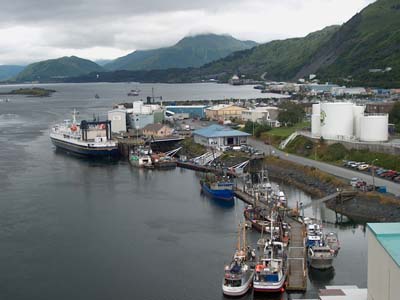 |
People in Kodiak have been great. We
ended on the front page of the local paper, which caused several
contacts. Finnish related Marya visited us with her
daughter Liz and son-in-law Andy. We were
asking about any possibilities for a sauna, and the next evening we were
taken to Carl and Naina. They call sauna
with the Russian word banja. In the corner was an impressive
stove and the heat was just as powerful as you could expect from the
amount of stones. And we enjoyed it! We sweated and scrubbed off all the
dirty skin. And felt thoroughly clean since a long time. After the bath
we sat in the cosy livingroom with walls full of interesting objects: a
three metres long baleen, a walrus scull with long teeth, different wood
carvings, and two narrow kayak paddles. The families of Carl and
Naina come from Scandinavia, Russia and Aleutians.
Aldona and Tom living opposite the harbour
invited us to their home, and we spent a pleasant evening in their
beautiful house. They lived nine years in their sailboat Equinoix, of
which three in Valdez. We got again good tips and a lot to think about.
Now we are considering Valdez instead of Cordova as a wintering place.
|

Kristiina on the front page of
Kodiak Daily Mirror!
|
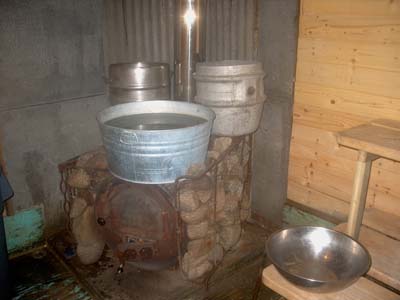
The massive stove of banja gave
perfect steamheat
|
As nice time we have had in Kodiak, it's
getting very expensive in the harbour and it's time to move on. Next we
are heading to Geographic Bay located on the Alaska
Peninsula. There should be a lot of bears. Harbour Master Marty pointed
out several sheltered anchorages on Kodiak, Afognak and Shuyak islands,
so there is plenty to explore.
24.8.2003 Geographic
Harbor, Alaska
 Click
the map to see our route on Kodiak and over the Shelikoff strait to
Alaska peninsula.
The past week in the nature harbours has been magnificent: superb
scenery, sheltered anchorages, smoked salmon, blueberries and lots of
animals - best of which the bears. Wait until we get to an internet and
put all the bear photos on the homepage!
But lets start from the beginning. We didn't go right away bear viewing,
because the forecest promised hard winds. Instead, we motored to the Izhut
Bay on Afognak Island, where we found a perfect
anchorage. On high tide we managed to hop over a shallow bank into a
round bay, which was like a Finnish lake. High spruce trees were growing
down to water edge. The mirrow calm water was broken only by salmon
jumps and a couple of sea otters, who came to see who entered their
territory. On our way we had catch our first salmon, and we smoked it in
our little smoke-box. That was delicious! We stayed three nights in the
bay, and during that time also the forecasted wind wiped over with rain.
One evening a young bear appeared to the shore and swam over to a little
knoll opposite us. It climbed up and ate something from a bush. We went
later to see what the bear had eaten, it was a blueberry bush. We had
been looking for blueberries - on ground. But we should have look up,
here the blueberries grow in bush. Neat, you don't hurt you back when
berrypicking. Well, the bear had finished that bush, but on our next
anchorage we found a lot of blueberries and got several litres in no
time.
The last weeks activities include also a visit to the Kitoy Bay
hatchery. Salmons are fertilized there, in a rather cruel
way, by cutting their stomacs open, taking the eggs or milt and mixing
them. The Pacific salmon will die after spawning, unlike the Atlantic
salmon, which maybe explains why the fish are killed instead of milking
them. Fertilized eggs are hatched in rich-oxygen water.
After emerging the fry is kept in fresh water tanks for a various
period, some species as long as one year. The young man introducing the
hatchery to us maneioned so many figures that we were confused, but if
we didn't get it all wrong, there were 35.000 salmon waiting in the end
of the bay to be "operated". One female carries some 1600
eggs, and the fertilation percentage is high, 80-90, so the hatchery
produces millions of salmon every year. After some years the salmon will
return to its birth waters, and in turn, might end to the cutting table.
The hatchery is located in the river estuary, but the river is blocked
so that the fish end up circling the bottom of the bay, where it is easy
to catch. Part of the salmon fry will be carried to various lakes in
Alaska. Fishermen are paying a percentage of their income to maintain
the hatchery.
One night we spent among the sea otters. Sea otter is a
funny creature. It swims and floats on its back. Belly functions as a
table from where it's handy to grab mouthfulls with the little pawns.
When the sea otter wants to see further, it streches it's neck up from
the water like a hairy skittle. Also a whale was spending the night with
us. We heard the long and strong blows from the dark night.
On Friday we left the Kodiak Islands behind us and crossed the infamous
but narrow (only 30 nm) Shelikoff Strait with beautiful weather: sunny
and 10-15 knot southerly wind. The Geographic
Harbor is a unic place to see the bears from close distance.
Not alone, though, since the place is not favoured by bears only but
humans as well. Ysterday there were eight nature photographers with huge
objectives and a group of six people with a guide on the strand. But
that is why you get close to the bears, they are used to people. Alone
we would not have gone even to the shore, now encouraged by the others,
we were as close as one-twp metres. Wriing this there are two motor
boats and three aeroplanes moored in the bay (which is not a good
anchorage for the uneven and deep bottom). Tourists are getting here by
small sea planes. Today the spot was also visited by two rangers. 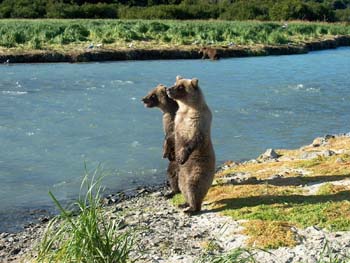
Cubs looking for the mom
Bears come to the river mouth to eat the
migrating salmon. There are various ways to fish. One is sitting on the
bank, diving from there to get a catch. Other is wading in the river
rushing every now and then after a fish. Although bear has bad
eyesight, it sees close quite well. The bear fishing from the embankment
was quite far from the water, but it must have been suitable distance
for it to see the salmons. It was concentrating on the water
before the dive. And got a fish pretty often. Bears started to fish
early in the morning, having a siesta during the high tide, when fishing
gets harder in the deep water. Today the high tide was in the midday,
perfect for the hot day. One moved from the bushes to sleep in the
water, obviously cooler there. The cubs are playing rather than
seriously fishing. Usually they get the fish from the mother, sometimes
with a fight. The males have a rank, sometimes someone gets chased or an
angry growl. Yesterday there were 10, today 18 bears at the same time.
These bears are brown bears, same than we have in Finland, and smaller
than the Kodiak bear. They weight 150-250 kg. Some of the males we saw
were at least that big, maybe even bigger. Female gives birth to 2-3
small size cubs, and nurses them for three years. Bear is defined as a
beast, and some species, for instance the Kodiak bear, are the largest
living land beasts. On the point, one photographer was advising us not to
generalise the behaviour of a bear by these ones. Elsewhere a bear can be
dangerous. It either runs away or attacks when meeting people. So it's
best to continue noise-making in the forest.
We have two weeks more in the wonderful nature before we have to be
in Seward, meeting Hannu's brother Jaakko and
Teijo, a friend of ours (and the commodore of our yacht
club) who are coming
for one week's visit.
1.9.2003 Seward, Alaska
The previous update was late because connection problems (there was
a power break in Helsinki.)
The month in Alaska has been uncredible wonderful. Every anchorage has
surprised us somehow, with new animals or different scenery. After the
bear bay, we stopped in a couple of places on the Alaska Peninsula
before sailing back to the northernmost island of Kodiak Islands, the Shuyak.
It's a state park, which means that you can fish, camp, boat, kayak and
hike. There are tracks and four rental cottages. Park is monitored by
rangers, two young men, who had a nice wooden lodge, big and new, which
we visited. We didn't see any bears on Shuyak, but that was only good.
On the previous anchorage at Hidden Bay we barely got to the
shore because the bears were constantly walking around the bay not
paying any attention to our shouting. On Shuyak we saw some tracks of
bear, but not the animals. It was nice to walk along the trails. The
forest was like in a fairytale: old odd-looking spruce tree covered with
soft moss. Even we made noise, we managed to see three deers.
On Shuyak we invented a new catch method: hookfishing. It's quite easy
to catch a salmon from the stream by the fish hook. And much more
exciting than luring. Besides, you can choose the fish you want. We have
been eating smoked, grilled, salted and cooked salmon.

New catch methd: hook fishing
We would have stayed longer
on Shuyak, but the forecast promised hard northerlies after a couple of
days, and we had 80 miles ahead of us to the Kenai Peninsula.
It seems that weather prediction is difficult here, it changes every six
hours. The hard wind never came, but we couldn't take the risk. We
motored 14 hours over the calm sea to the mainland, slept, and continued
the next day along the coast towards Seward. A new animal sight was a
mountain goat. They are so high up on the mountain slopes that only
binoculars prove them to be live animals. White spots on the green
background are easy to see.
Thunder Bay, our anchorage before Seward, was again very
beautiful and different. Waterfalls, one really big one, were running
down the steep and high slopes. There were two salmon streams in the
inner bay, and black bears this time. They are smaller
than the brown bears we saw. But as fat of all the salmon they have
eaten. And berries: all the blueberry and cranberry bushes were empty.
There was enough salmon for us all, the bears, tens of screaming sea
gulls and us. So we went hookfishing. First we had to noise the two
fishing black bears away. Their big, fat asses jumping they run into the
bushes. Hannu went to the river, Auli remained in the dinghy with
camera. Suddenly we heard growling on the spruce tree above the river,
and two angry black bear faces were peeping through the branches! So it
was proved that a bear can climbe a tree. There they continued arguing
against the intruder. Hannu almost escaped to the dinghy, but hold his
mind cool and got a fish. We left, leaving the stream with its tens of
salmons to the bears.
There was a tiny, shrinken glacier in Thunder Bay. We walked to it and
took a piece of ice. Later we saw a wolverine on the beach. When the dim
started to turn in, we made a fire of drift wood and sat there with
black bear mother and three cubs fishing salmon the low tide had
captured in the stream only 150 metres from us.
6.9.2003 Seward, Alaska
We know three people from Alaska, and two of them, Andy and Lisa
from sv Indefatigable are sailing somewhere between NZ and
Hawaii. Third person, Nina, walked to us on the harbour
dock! We met Nina in New Zealand in November 2002, when she was selling
her gorgeous wooden sailing boat built in the beginning of 20th century.
Knowing a local changes always everything. We can use shower in the
yacht club instead the yacky two-dollar public shower. And the best:
Nina offered to drive us to the Anchorage airport to meet our visitors,
Hannu's brother Jaakko and our friend Teijo. Namely, it's not that easy
to travel here. Public transportation is limited and the schedules
didn't match. The only car rental company asks 150 dollars for one day.
It will be interesting to find out how we get the men to airport from Whittier,
the place we have planned as our destination. After the tourist season
there is no public transportation at all from Whittier to Anchorage (the
last train goes two days, and the last bus one day before the guys
leave!), there is no taxis or rental cars.
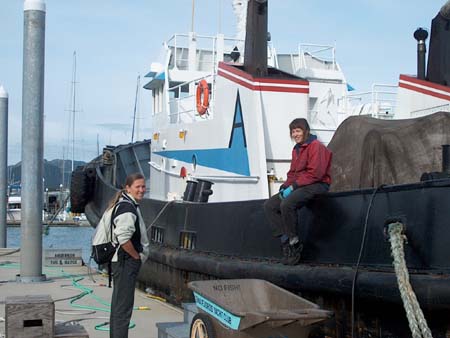
Nina works on a tug boat. Unbelievable to
meet by coincidence!
Also the 3000 inhabitants' Seward
lives on tourism. Between May and September four big cruising ships
visit the town every week. There are tens of smaller and bigger charter
companies. Tourists are taken out to the fjord to see glaciers, marine
mammals and scenery. There are fishing tours and kayak rentals. The
shore side is full of RVs. Seward is the end of highway, about 200 km
(130 miles) from Anchorage, a 2,5 hour drive. Naturally, tourism affects
the town image. There is a "tourist-village" near the harbour:
charter offices, bars, cafés, restaurants and souvenier shops. The
atmosphere is totally different than in Kodiak. We got a slip from the
charter boat dock, where nobody says hi or comes to chat.
But there are some positive things too, for instance a sauna! Seward's
vocational college has a sport hall and sauna for four dollars. Stones
are hot and there is a real sauna bucket for water. Yesterday we met
there a girl with a Finnish last name, Nikkari. However, the third
generation American didn't speak any Finnish.
Now we are eagerly waiting for Jaakko and Teijo (and rye
bread). We hope that the guys get as pleasant weather as we have had: 15
deg C and clear skies. Our intention is to spend the week in Prince
William Sound (see tha map above), which is said to be the most
beautiful place on this area.
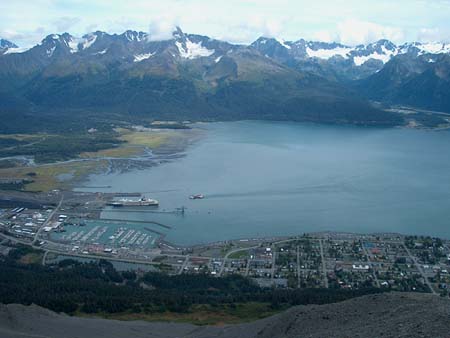
Seward
Hannu climbed to Mt. Marathon, which is raced every 4. of July
It took three hours for Hannu,
the race record is 43 minutes!
14.9.2003 Whittier,
Alaska
 Jaakko
and Teijo arrived to the Anchorage airport on schedule on Sunday evening
bags full of books, magazines, rye bread, salmiak, koskenkorva and
greetings. On Monday we stayed in Seward, tried to catch some salmon
among other things. Because salmon doesn't eat when spawning, the style
was similar to our hook fishing: there is only a hook and weight you
throw into water hoping that the hook finds a fish. So special and new
style that finally we had to buy a salmon from the guy next to us. It
costed 10 dollars, the fishing license 10, and hooks another 10, so it
became quite a costly fish. But tasty!
On Tuesday we started to head towards Prince William Sound. We have had
wonderful weather the whole week, but bear viewing has limited to one
shy black bear. Also catching salmon from the rivers didn't go as
planned: now salmons are really dying or dead. Rivers stink far of the
rotten fish that is lying in the water and along the shores. All our
smoking wood has stayed untouched. Instead of smoking salmon we have
grilled sausages.
Offshore we saw some Steller sealions. They are around 1000 kilos, big
and fat, much bigger than the sealions we saw on the Galapagos Islands.
When we entered Prince William Sound along the narrow Bainbridge
Passage, a whale research boat was calling us asking for any
whale sights. Later we saw four humpbacks, which we reported to the
researchers.
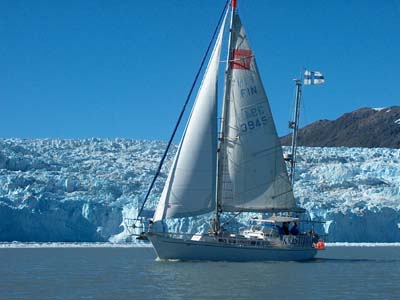
A new and magnificient scenery was a glacier. We motored to Icy
Bay, full of ice - of course. Ice blocks - or bergy bits - were
much smaller than in Greenland, but we managed to moor Kristiina along
one piece (don't do this, the ice blocks can turn around). In the end of
Icy Bay was active Chenega glacier, which means that bits
of ice are constantly falling off - with a big bang. In front of the
glacier was a dense area full of ice, and a lot of seals sunbathing on
the ice floats. As we had four people onboard, we took some photos of
Kristiina in front of the ice - as all the high latitude sailors do.
Teijo went for a swim every
morning (the water is about 5-8 deg C) and got finally Auli to join him.
We'll see if Auli's old habit of winter swimming will continue after the
guests have left.
|

Ice...
Ice swimmer Teijo
|

...and fire
Auli and two times Aulin
|
The week has gone quickly.
We motored to Whittier (population about 300) from where a
friend of Nina, Anna, will take Jaakko and Teijo to Anchorage. There is
no other transportation than private cars out of Whittier either. The
town was once built as a military base. Presently it is famous of being
the ugliest place in Alaska - not for vain. Well, that is one kind of
sight, too.
After the guys are gone we will continue exploring the Prince William
Sound.
Previous
- Next
|